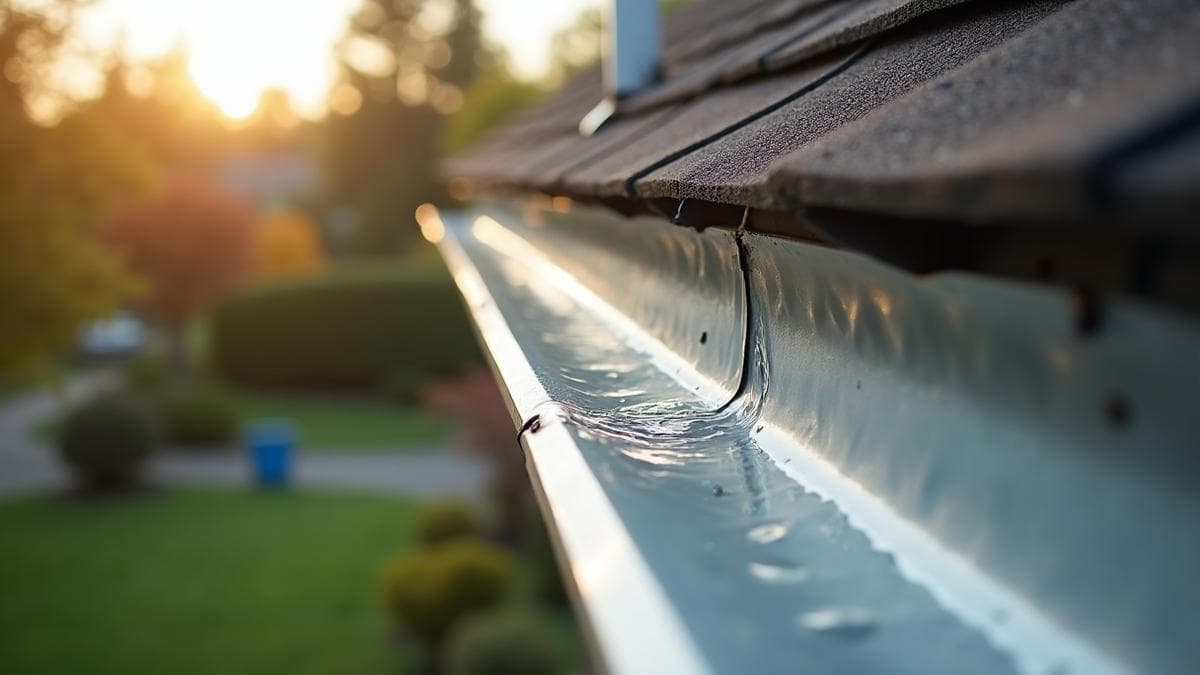
Most Wheat Ridge homes need 5-inch gutters, but steep roofs, large roof planes, and areas that catch heavy spring snowmelt often require 6-inch systems. Colorado's combination of rapid snowmelt, intense summer thunderstorms, and high-altitude UV exposure makes proper gutter sizing critical to protecting your foundation and siding.
Undersized gutters overflow during May snowmelt and July cloudbursts. Oversized gutters cost more and look bulky. The right size moves water fast enough to prevent ice dams in winter and handles the volume when a Chinook wind melts two feet of snow in 48 hours.
How Much Water Do Front Range Gutters Actually Handle?
A 1,000-square-foot roof section sheds roughly 600 gallons of water during a one-inch rainstorm. Denver-metro summer thunderstorms routinely drop one to two inches in under an hour. Spring snowmelt adds another variable: a sunny March afternoon can dump the equivalent of a half-inch rain event as snow slides off south-facing slopes.
Standard 5-inch residential gutters with 2x3-inch downspouts handle up to 2,500 square feet of roof area in moderate-pitch applications. That works for most ranch homes in Wheat Ridge and Arvada. Steeper pitches (8:12 or higher), metal roofs that shed snow fast, and roof valleys that concentrate flow all push more volume into the gutter. Those situations call for 6-inch gutters with 3x4-inch downspouts.
We see overflow problems most often on two-story homes where an upper roof drains onto a lower section. The lower gutter receives double the normal load. A roof inspection identifies these high-volume zones before you install new gutters.
What Gutter Size Does a Wheat Ridge Home Need?
Start with your roof pitch and square footage per section. Measure from ridge to eave, then along the roofline. Multiply to get the area that drains to each gutter run.
- 5-inch gutters: Standard for single-story ranch homes, roof pitches under 6:12, and roof sections up to 2,500 square feet. Handles typical Front Range rain and moderate snowmelt.
- 6-inch gutters: Required for steep pitches (7:12 and up), two-story homes, metal or tile roofs that shed snow quickly, and any section over 2,500 square feet. Also smart for north-facing slopes that dump heavy wet snow in spring.
- Downspout sizing: 5-inch gutters use 2x3-inch downspouts; 6-inch gutters need 3x4-inch. Space downspouts every 30 to 40 feet, closer on high-volume runs.
Wheat Ridge sits at 5,400 feet. High-altitude sun melts snow faster than the same temperature at sea level. If your roof faces south or west, plan for quick melt events that fill gutters in minutes. A seamless gutter installation custom-fits each run to your exact roof geometry and pitch.
Do Gutter Guards Change the Size You Need?
Gutter guards reduce debris but do not change the hydraulic capacity of the gutter itself. A 5-inch gutter with a guard still moves the same volume as a 5-inch gutter without one. Some micro-mesh guards slightly reduce flow during extreme downpours because water sheets over the guard instead of entering the gutter. That effect is minor in properly sized systems.
Guards do help in winter. They prevent pine needles and shingle grit from forming dams that trap snowmelt and cause ice buildup. If you live near open space or have mature cottonwoods, guards keep gutters flowing when you need them most. They do not replace correct sizing.
We install guards after confirming the gutter itself can handle your roof's load. Putting a guard on an undersized gutter just means the overflow is cleaner.
How Do Freeze-Thaw Cycles Affect Gutter Performance?
Colorado winters cycle above and below freezing daily. Snow melts on your roof during the afternoon, runs into the gutter, then refreezes at night. Undersized gutters trap that water and turn into ice troughs. The ice expands, pulls fasteners loose, and bends the gutter away from the fascia.
Proper slope is critical. Gutters should pitch 1/4 inch per 10 feet toward the downspout. That grade keeps water moving so it exits before nighttime temps drop. We see a lot of flat or back-sloped gutters in older Wheat Ridge neighborhoods. Those gutters hold water, freeze solid, and fail within a few seasons.
Larger gutters handle freeze-thaw better because they have more volume to absorb ice expansion without deforming. A 6-inch gutter gives you a margin of safety during those late-winter cycles when daytime highs hit 50 and nights drop to 15.
If you already have ice-dam problems, a roof repair might be needed in addition to new gutters. Ice dams form when heat loss through the roof melts snow unevenly. Gutters move the water once it reaches the edge, but they cannot fix the heat-loss issue upstream.
What About Commercial Buildings and Flat Roofs?
Commercial buildings and flat roofs use internal drains or scuppers instead of traditional gutters, but the sizing math is the same. You calculate roof area, apply a rainfall-intensity factor, and size the drain to handle peak flow.
Flat roofs in the Denver metro need to drain fast because ponding water freezes, and ice is heavy. A 10,000-square-foot flat roof holding two inches of water carries more than 10,000 pounds of extra load. That water needs to exit through properly sized drains and downspouts before it freezes.
We handle commercial roofing projects in Wheat Ridge, Lakewood, and throughout the metro. Gutter and drainage sizing is part of every flat-roof install. The building code sets minimum drain spacing and size, but Front Range weather often requires more capacity than the code minimum.
How Much Does Seamless Gutter Installation Cost in Wheat Ridge?
Seamless aluminum gutters run roughly $8 to $12 per linear foot installed for 5-inch systems, $10 to $15 per foot for 6-inch. A typical single-story home needs 120 to 180 feet of gutter, so expect $1,200 to $2,500 for a full install. Two-story homes or complex rooflines with multiple valleys cost more because they require more downspouts and custom fittings.
Copper gutters cost $25 to $40 per foot. Steel costs $10 to $18 per foot. Aluminum is the best value for most Front Range homes because it does not rust, handles freeze-thaw well, and comes in colors that match your trim.
Add $3 to $6 per foot if you want gutter guards installed at the same time. Fascia repair or replacement adds $8 to $15 per foot if the old gutter pulled the board loose. We give you a written estimate after measuring your roofline and checking fascia condition. Our cost guide breaks down pricing for different materials and configurations.
We beat any written competitor bid by $100, or donate $100 to a charity of your choice. That is our Best Price Promise, and it applies to every gutter job.
When Should You Replace Gutters Instead of Repair?
Replace gutters if they sag more than an inch, have rust holes, or pull away from the fascia in multiple spots. Small leaks at seams can be sealed, and individual brackets can be refastened, but widespread damage means the system is done.
Sectional gutters (the kind with joints every 10 feet) leak at the seams after a decade or so. Seamless gutters eliminate those joints. If you have sectional gutters that leak in three or more places, replacement with seamless is smarter than patching.
Gutters also fail when the fascia rots. If the board behind the gutter is soft or stained, the fasteners will not hold. We replace the fascia first, then hang new gutters on solid wood. Skipping the fascia repair just means the new gutters will sag within a year.
Hail dents gutters. Front Range hail season runs May through September, and a severe storm can dimple aluminum gutters beyond repair. If you filed a roof insurance claim for hail damage, ask the adjuster to inspect the gutters too. Most policies cover gutter replacement if hail caused the damage.
Ready to Size and Install Gutters That Handle Colorado Weather?
Best Roof and Gutter offers free gutter inspections and written estimates in Wheat Ridge, Arvada, Lakewood, and across the Denver metro. We measure your roof, calculate the load, and recommend the right gutter size and downspout spacing for your home. Our seamless systems are custom-formed on site, so every run fits perfectly with no leaky seams.
Call us at (303) 529-7095 to schedule your free inspection. We will walk your roofline, check your fascia, and give you a written quote the same day. With 4.3 stars across 123 reviews on Google and Yelp, we have the track record to back up the work.
What do gutters actually cost in Denver?
We publish our real installed price ranges, line by line, so you can compare any bid against them.
See real Denver gutter pricing →